
Progressive Overload with Kettlebells: 7 Methods Beyond Adding Weight
Adding weight isn't the only way to progress with kettlebells. Here are 7 research-backed methods to drive adaptation without jumping bell sizes.
If you train with barbells, progressive overload is simple. Slap another 2.5 kg on the bar. Done.
Kettlebells don't work that way. The jump from a 24 kg to a 32 kg bell is a 33% increase. Try doing that with your squat and see what happens to your spine. Even the more reasonable 24-to-28 kg jump is still roughly 17%, which is massive compared to the microloading options barbell athletes enjoy.
This creates a real programming problem. Progressive overload is the foundational driver of adaptation. A 2019 systematic review by Plotkin et al. in Sports Medicine confirmed that progressive increases in mechanical tension produce both hypertrophy and strength gains. You need to keep pushing the envelope. But if the weight options are limited, you have to get creative.
Here are seven concrete methods to drive progressive overload with kettlebells, all without touching a heavier bell.
1. Add Reps (The Obvious One)
Let's get this out of the way first. If you did 5 sets of 5 presses last week, aim for 5 sets of 6 this week. Simple volume accumulation.
But this has a ceiling. Once you're doing sets of 12-15 on a movement like the press or front squat, you're shifting the adaptation stimulus away from maximal strength and toward muscular endurance. That's fine if endurance is your goal. If it isn't, you need other tools.
2. Add Sets (Total Volume Loading)
Instead of adding reps per set, add sets. This lets you keep each set in a lower rep range while still increasing total session volume.
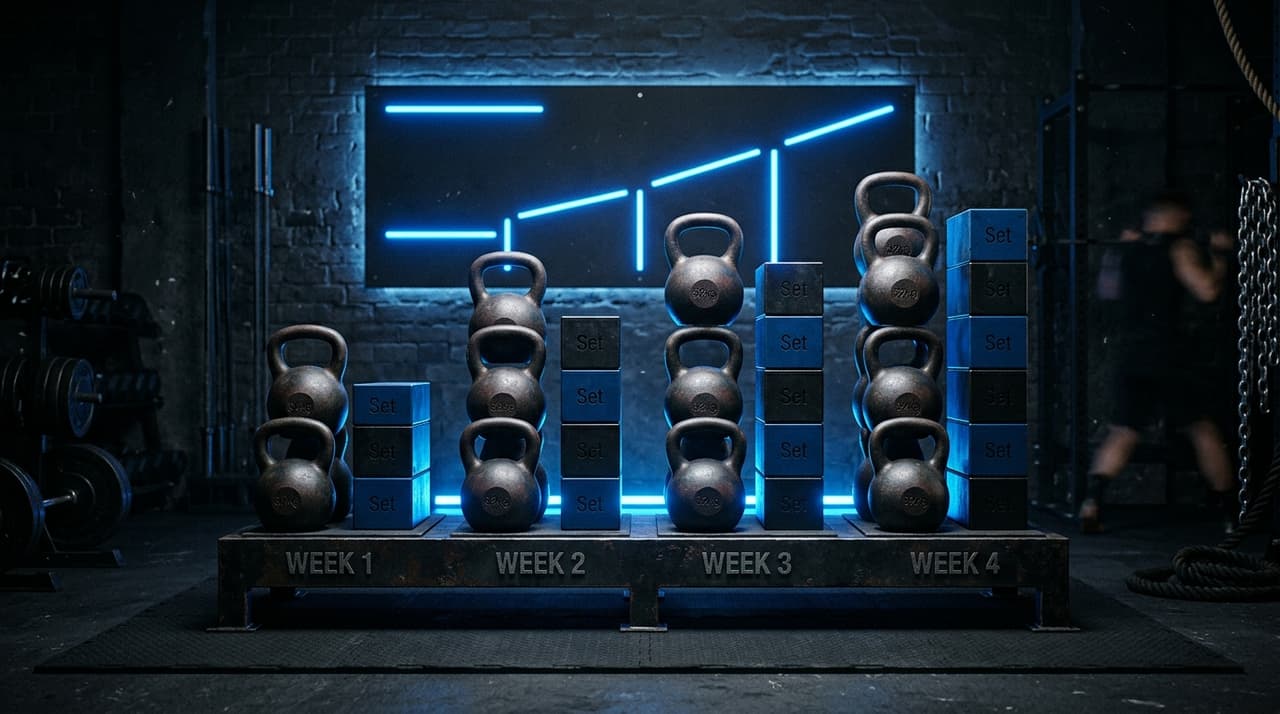
A practical example: Week 1 might be 4x5 presses at 24 kg (total volume: 2,400 kg). Week 4 becomes 6x5 at the same weight (3,600 kg). That's a 50% increase in total tonnage with zero change in bell size or rep scheme.
Schoenfeld et al. (2017, Journal of Strength and Conditioning Research) found a clear dose-response relationship between weekly set volume and hypertrophy. More sets meant more growth, up to a point. For most trainees, somewhere around 10-20 hard sets per muscle group per week works well.
3. Manipulate Rest Intervals
Doing the same work in less time is a legitimate form of overload. If you completed 5x5 swings with 90 seconds rest last month and you're now doing it with 60 seconds rest, your work capacity has improved.
This method works especially well for conditioning-focused goals. And it pairs naturally with timed protocols. Rest interval manipulation has distinct effects on hypertrophy versus strength outcomes, so be intentional about which adaptation you're chasing.
If you're using EMOM or timed interval formats, FlowTimer makes it easy to systematically shorten rest periods across training blocks without losing track of your protocol.
4. Increase Density (Same Work, Less Total Time)
Density is closely related to rest manipulation but takes a wider view. Instead of just cutting rest between sets, you're looking at total session output divided by total session time.
Say you complete 100 swings in 20 minutes during Week 1. By Week 4, you complete 100 swings in 14 minutes. Same external load, same reps, dramatically higher training density.
A 2012 study by Haddock and Wilkin in the Journal of Strength and Conditioning Research examined kettlebell swings and found significant metabolic and cardiovascular demands even at moderate loads. Increasing the density of swing work amplifies those demands without needing to increase the bell weight.
5. Slow Down the Eccentric
Tempo manipulation is underused in kettlebell training. Adding a 3-4 second eccentric (lowering) phase to goblet squats, presses, or Turkish get-up transitions increases time under tension significantly.
A 24 kg goblet squat with a 4-second eccentric feels entirely different from the same weight at normal tempo. Schoenfeld et al. (2015, Sports Medicine) found that eccentric actions at longer durations can produce substantial hypertrophic stimulus, partly through increased mechanical tension and metabolic stress.
This works especially well for movements like the press, where the eccentric is easy to control. It's less practical for ballistic movements like swings and snatches, where deceleration is part of the skill.

6. Progress the Movement Complexity
A two-hand swing is easier than a one-hand swing. A one-hand swing is easier than a clean. A clean is easier than a snatch. You can progress through more demanding movement patterns at the same weight.
This isn't just about making it harder. More complex movements recruit additional muscle groups, demand greater stabilization, and challenge coordination. A 24 kg double kettlebell front squat and a 24 kg single-bell pistol squat use the same total load, but the pistol squat demands dramatically more from your quads, hip stabilizers, and ankle mobility.
Here's a simple progression ladder for common kettlebell patterns:
| Pattern | Level 1 | Level 2 | Level 3 | Level 4 |
|---|---|---|---|---|
| Hinge | Two-hand swing | One-hand swing | Clean | Snatch |
| Squat | Goblet squat | Racked squat | Double front squat | Pistol squat |
| Press | Two-hand floor press | Half-kneeling press | Standing press | Bottoms-up press |
| Carry | Farmer's carry | Rack carry | Overhead carry | Mixed carry (rack + OH) |
Each step to the right represents meaningful overload without changing the bell.
7. Use Complexes and Chains to Extend Sets
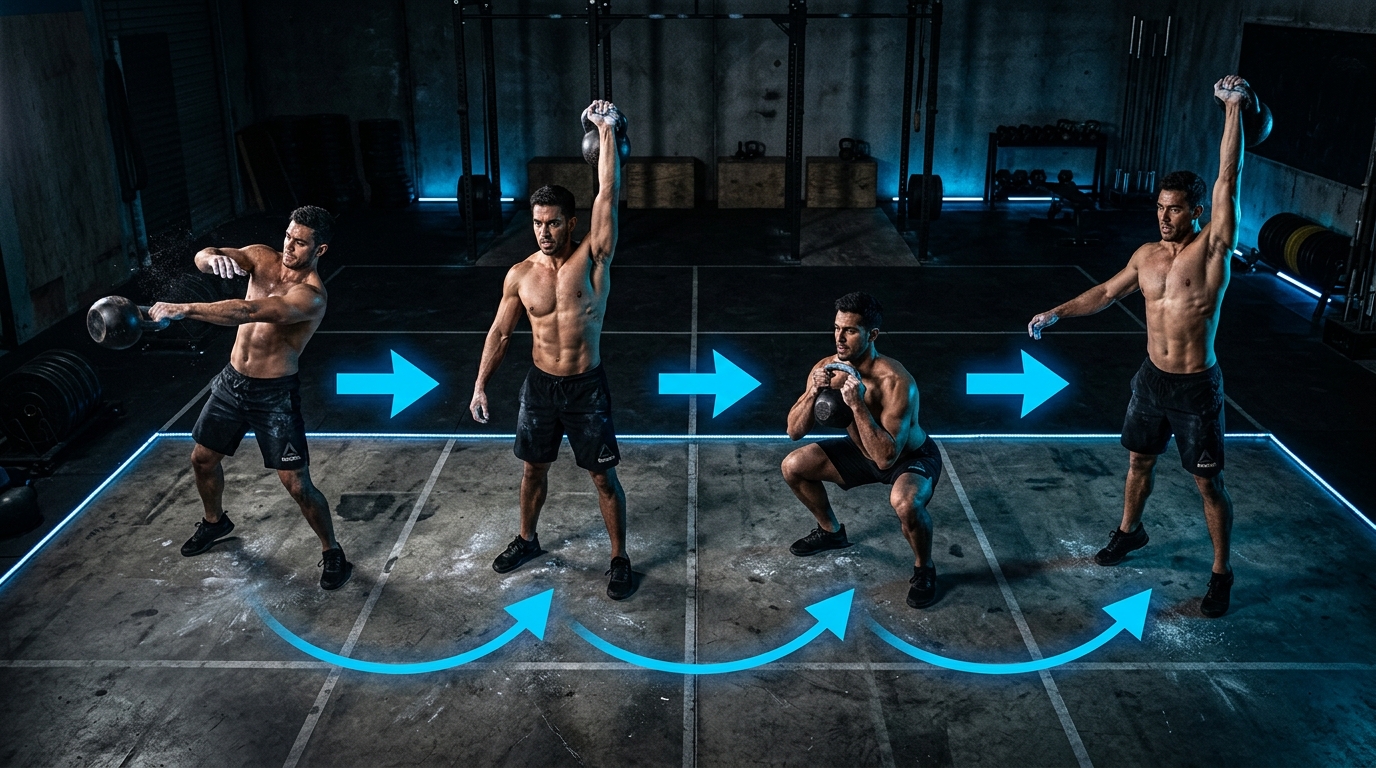
A complex strings multiple movements together without putting the bell down. A chain does the same but changes reps across movements. Both methods increase total work per set and accumulate fatigue strategically.
Week 1 might be: Clean x 3 + Press x 3 (six total reps before putting the bell down). Week 4 becomes: Clean x 3 + Press x 3 + Squat x 3 + Snatch x 3 (twelve total reps). Same weight. Double the work per set.
This is a hybrid of methods 1, 4, and 6 combined. You're adding reps, increasing density, and layering movement complexity simultaneously. The total-body fatigue generated by a well-designed complex at moderate weight is surprisingly intense.
Putting It All Together
The mistake most kettlebell athletes make is relying on only one of these methods. The real power comes from rotating through them across a training block.
A simple 4-week progression might look like this: Weeks 1-2, add reps. Week 3, add a set and reset the reps. Week 4, reduce rest intervals and test the new density. Then start the next block with a more complex movement variation and repeat.
This is how you make a single kettlebell last months or years of productive training. The weight doesn't need to change if the demand keeps climbing.
Training with timed intervals helps make several of these methods measurable. Time-based protocols like EMOMs naturally create the structure for density and rest manipulation, turning abstract concepts into concrete, trackable sessions.
You don't need a rack of 15 different kettlebells. You need a system. Pick two or three of these methods, build them into your programming, and you'll keep progressing long after you thought you'd outgrown your bell.
Ready to put this into practice? FlowTimer lets you build custom interval workouts, set precise work-to-rest ratios, and train with audio cues so you can focus on your form.
Try FlowTimer Free