

AMRAP vs EMOM: Which protocol fits your training goal?
AMRAP and EMOM look similar on paper but train different qualities. Here's how to pick the right one for strength, conditioning, or skill work.
AMRAP and EMOM are the two protocols I see most often in kettlebell programming, and they get used almost interchangeably. They shouldn't be. The structures look similar (a clock, some reps, a movement), but they train different qualities and reward different mindsets. Picking the wrong one for your goal is a slow way to spin your wheels.
Here's the choice.
What each protocol actually does
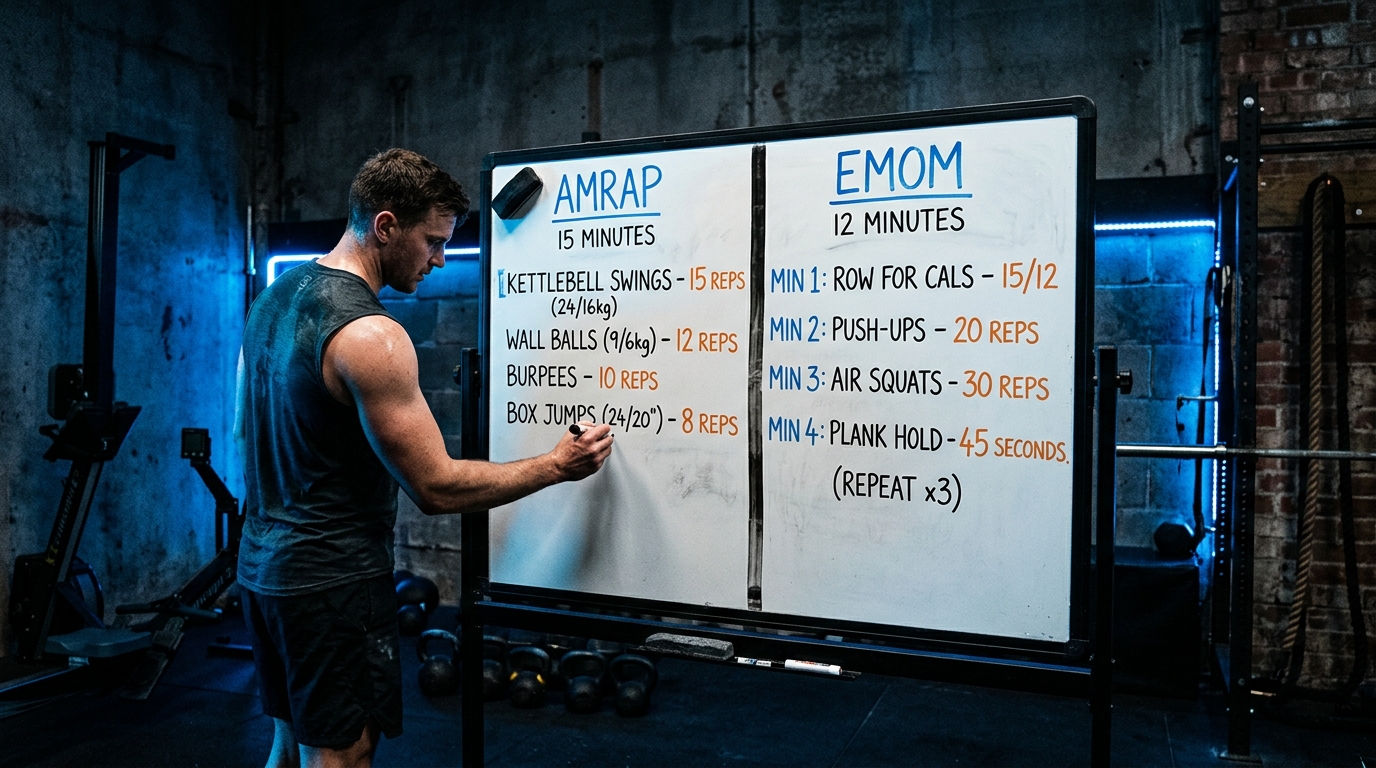
AMRAP means "as many reps as possible" inside a fixed window. You start the clock, you go, and you don't stop until time's up. Pacing is on you. So is suffering.
EMOM means "every minute on the minute." You perform a prescribed number of reps at the top of each minute, and whatever time is left becomes rest. The clock decides when you work. You decide how efficient you are with what's left.
The critical difference: AMRAP is open-ended output, EMOM is fixed output with variable rest. That single distinction changes almost everything about how the session feels and what it builds.
What the research says about work-to-rest structure
A 2019 study in the Journal of Strength and Conditioning Research compared self-paced versus prescribed-rest interval protocols. Prescribed rest (the EMOM model) produced more consistent power output across sets. Self-paced work (the AMRAP model) produced higher total volume but with significant power decay in the final third.
That tracks with what you'd predict mechanically. When rest is fixed and adequate, phosphocreatine resynthesis stays ahead of demand and bar speed holds. When rest collapses (and it does in any honest AMRAP), you shift toward glycolytic territory, lactate climbs, and rep quality drops even if rep count keeps going up.
So the question isn't which is harder. They're both hard. The question is what kind of hard you want.
When EMOM wins
EMOMs are the better choice when rep quality matters more than total volume. That's most situations:
- Strength-skill work. Heavy cleans, snatches, get-ups, anything where technique degrades fast under fatigue. The forced rest keeps each rep clean.
- Power development. If you're chasing bar speed or jump height, you need recovery between efforts. EMOMs give it to you automatically.
- Building work capacity progressively. You can add reps per minute over weeks and track the change cleanly. The clock is the same. Only your output changes.
- Beginners learning to pace. EMOMs teach restraint. You can't sprint the first round, because round two starts whether you're ready or not.
If you're new to programmed intervals or want a deeper breakdown of how to build EMOMs around strength goals, the complete EMOM guide covers structure and progression in detail.
When AMRAP wins
AMRAPs shine when the goal is conditioning, mental toughness, or testing fitness:
- Conditioning under fatigue. AMRAPs train you to keep moving when you don't want to. That's a real adaptation, both physiological and psychological.
- Benchmarking. Same workout, same time domain, periodically retested. Total reps is a clean number to track. Did you do more this month than last month? Good.
- Glycolytic capacity. If you want to develop the ability to buffer lactate and keep working, AMRAPs put you there.
- Mental work. There's no rest hiding behind the clock. You decide when to slow down, and that decision-making under fatigue is a trainable skill.
The trade-off is honest: rep quality drops as the AMRAP progresses. Your last minute of a 12-minute AMRAP doesn't look like your first. That's fine if conditioning is the goal. It's a problem if you're trying to build strength.
A simple decision framework
Ask two questions before you program either one.
First: does rep quality matter for what I'm training? If yes (strength, power, technique), EMOM. If the goal is volume or sustained output under fatigue, AMRAP works.
Second: how heavy is the load relative to your max? Anything above 70% of your training max needs structured rest. EMOM. Lighter loads, especially in the 40-60% range used for conditioning, can handle the chaos of an AMRAP.
Load is the tiebreaker most people miss. A heavy double-kettlebell clean EMOM at the top of each minute trains something completely different from an AMRAP of the same movement at the same weight, even though the total work might be similar. The first builds strength under fatigue. The second turns into a survival exercise where form goes first and the kettlebells get lighter every minute in your head.
Programming both in the same week
You don't have to pick one forever. Most well-built kettlebell weeks include both, just not on the same day and not for the same purpose.
A reasonable split:
- Two strength-focused EMOM sessions (heavier loads, lower reps per minute, plenty of rest built in)
- One AMRAP conditioning session (lighter loads, sustained output, 8-15 minutes)
- One skill or technique day with no clock pressure
The EMOMs build the engine. The AMRAP tests it. The skill day keeps movement quality from drifting.
If you're running both, you need a timer that handles them without fuss. Set up your AMRAP and EMOM templates in FlowTimer once and you can pull them up instantly without rebuilding the structure each session.
The mistake I see most often
People pick the protocol based on how it sounds rather than what it does. AMRAP sounds harder, so they default to it for everything. Then they wonder why their cleans look ugly six weeks in, or why their snatch numbers haven't moved.
The protocol isn't the workout. The protocol is the container. What you put in it (load, movement, intent) determines what you actually train. EMOMs and AMRAPs are tools, and once you stop treating them as interchangeable, your programming gets sharper fast.
Pick based on the adaptation you want. Let the clock serve the goal, not the other way around.
Ready to put this into practice? FlowTimer lets you build custom interval workouts, set precise work-to-rest ratios, and train with audio cues so you can focus on your form.
Try FlowTimer Free