

How to structure a kettlebell complex that actually trains something
Most kettlebell complexes are just random exercise lists. Here's how to build one that targets a specific adaptation and gets results.
A kettlebell complex is one of the most efficient training tools on the planet. Five movements, one bell, no putting it down until the round is over. The problem is that most complexes you see online are just lists of exercises someone strung together because they looked cool on Instagram. They train a vague sense of "hard" without targeting any specific adaptation.
A good complex does one thing well. A great complex does that one thing on purpose.
What a complex actually is (and isn't)
A complex is a sequence of exercises performed back-to-back with the same implement, without setting it down between reps or movements. You finish all reps of exercise A, flow into exercise B, then C, and so on. One round.
If you put the bell down, it's a circuit. Circuits have their place, but they're a different tool. The continuous loading is what makes a complex uniquely brutal on grip, breathing, and positional endurance under fatigue. That unbroken time under tension produces different metabolic and hormonal responses than equivalent work with rest between movements.
So when you're building a complex, the first question isn't "what exercises?" It's "what am I actually trying to develop?"
Pick your target adaptation first
Here are the three adaptations a complex can realistically train. Pick one per session.
Heavy bell, low reps per movement (2-5), 3-5 movements, longer rest between rounds (2-3 minutes). This is strength-endurance. You're trying to maintain force production while accumulating fatigue. Think double cleans, presses, front squats.
Moderate bell, moderate reps (5-8), 4-6 movements, short rest (60-90 seconds). This is the classic "complex as cardio" approach. You're pushing into the upper aerobic zone and bouncing in and out of threshold. If you don't know what that means for your heart rate, check the heart rate zones guide.
Lighter bell than you'd think, explosive reps (3-5), 3-4 ballistic movements, full recovery (3+ minutes). That's power-endurance. Snatches, swings, jerks. The goal is maintaining bar speed and power output across rounds, not surviving them.
The mistake I see constantly: people load a conditioning complex like a strength complex, then wonder why their form falls apart by round three. Match the load to the goal.
The structural rules that make complexes work
Once you know your adaptation, the exercise selection follows a few principles.
Order by mechanical demand, not by what feels natural. The most technically demanding or explosive movement goes first, when you're fresh. Snatches before presses. Cleans before squats. The grinding work and isometric holds go last because they're more forgiving as fatigue accumulates.
Transitions should be free. A good complex flows because each movement ends in a position that starts the next one. Clean ends in the rack, which starts the press. Press ends overhead, which starts the squat (overhead squat) or returns to rack for a front squat. If you have to reposition the bell awkwardly between movements, you've designed a circuit, not a complex.
Minimum 3 movements, maximum 6. Below 3 it's a couplet or just a set. Above 6 you're either forgetting the sequence or so deep in fatigue that the later movements turn into garbage reps. Five is the sweet spot.
Rep counts should be honest. If you can do 10 reps of every movement in your complex without breathing hard, the load is too light. If you can't complete 3 clean reps of the hardest movement after round one, the load is too heavy. The middle movements should feel hard but technically intact.
A template that actually works
Here's a structural template for a single-bell conditioning complex:
| Movement | Reps | Why it's here |
|---|---|---|
| Swing | 8 | Warms the posterior chain, sets breathing rhythm |
| Clean | 5 | Transitions bell to rack, hits the pull |
| Press | 5 | Loaded overhead under existing fatigue |
| Front squat | 5 | Legs while bell is already racked |
| Reverse lunge | 4 each side | Unilateral finisher, free transition from squat |
Do it on one side, switch hands, repeat. That's one round. Rest 90 seconds. Five rounds total. You'll know within two sessions if the load is right.
The principle here matters more than the specific exercises. Each movement starts where the last one ended. The hardest skill (clean) comes early. The most forgiving movements (squat, lunge) come late.
Programming complexes into a week
A complex session is genuinely taxing. Two per week is plenty for most people. Three is the upper limit if you're not doing much else. The continuous grip demand alone takes 48-72 hours to fully recover from at moderate loads, which is why I usually pair complex days with lower-body or skill work in between.
If you're stacking complexes alongside other modalities, the same autoregulation principles apply. Some days you load up. Some days you cut a round. The complex framework doesn't care if you do 3 rounds or 6, as long as the rounds you do are quality.
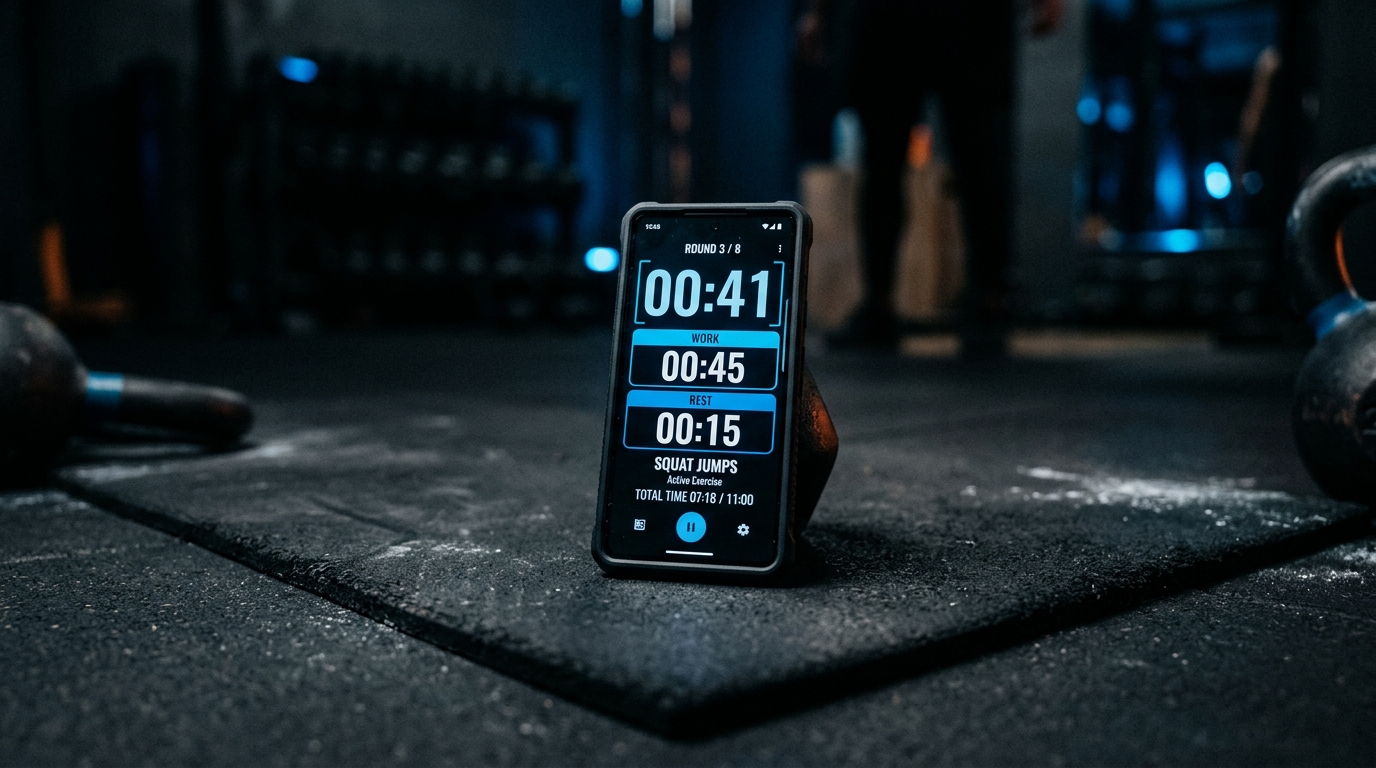
This is also where having a timer that handles rounds and rest automatically becomes a quiet game-changer. Counting in your head while gasping is how reps get skipped and rest periods stretch. Set up your complex in FlowTimer with the rounds and rest pre-programmed, and you can focus on the work instead of the math.
Progressing a complex over time
Once you've built a complex you like, don't change it for at least four weeks. Progress within the structure first.
Week 1, establish the baseline. Same bell, same reps, log your rest. Week 2, drop rest by 15 seconds per round. Week 3, add a round. Week 4, go up in bell weight and reset rest. Four weeks, four progressions, no exercise swaps.
This is what separates people who get strong from complexes and people who just collect them. Novelty is fun. Repetition with progression is what builds adaptations.
The honest summary
Most complexes fail because they're designed backward. Someone picks exercises they like, slaps a rep scheme on top, and hopes the workout produces something useful. A complex that actually trains something starts with the adaptation you want, picks a load that matches it, sequences movements by mechanical demand, and gets repeated long enough to drive progress.
That's it. The structure is simple. The discipline of sticking with one well-built complex for a month is the hard part.
Ready to put this into practice? FlowTimer lets you build custom interval workouts, set precise work-to-rest ratios, and train with audio cues so you can focus on your form.
Try FlowTimer Free