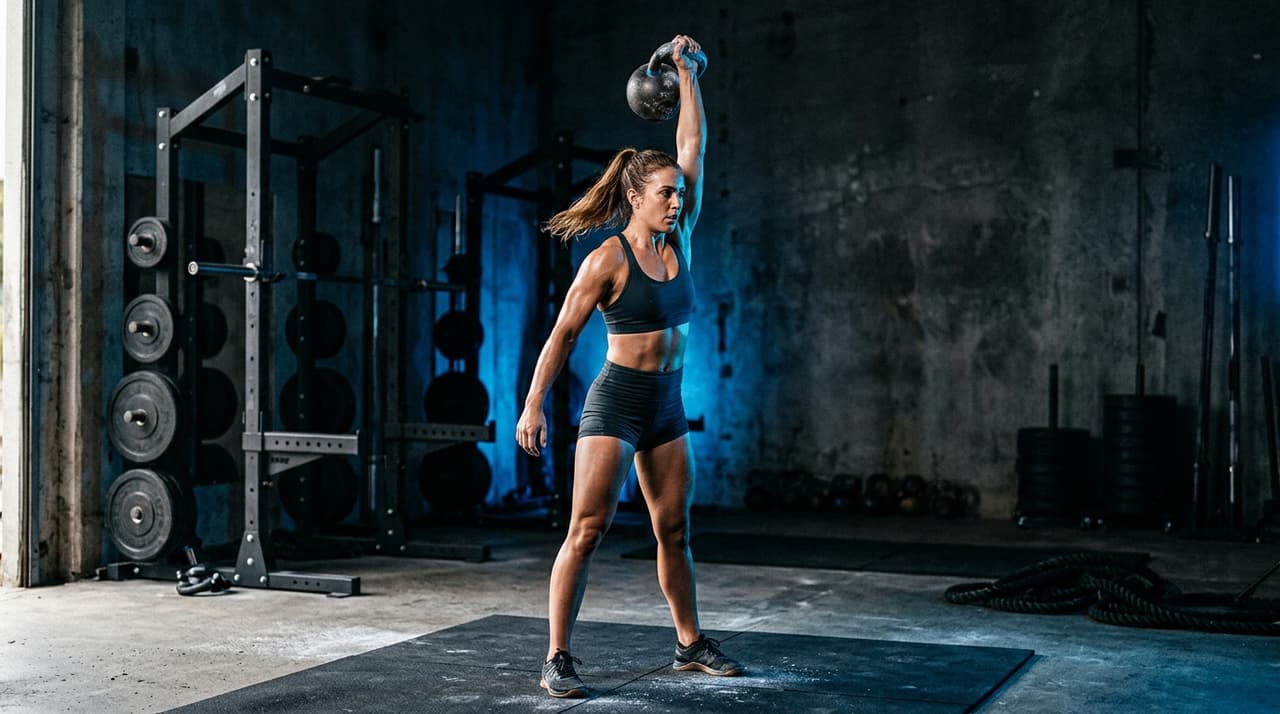
The kettlebell goblet squat: why it's the most underrated leg builder you own
The goblet squat teaches position, builds real leg strength, and exposes weaknesses no barbell squat will. Here's how to actually use it.
The goblet squat gets treated like a warm-up. A stepping stone. Something you do for two sets before the "real" leg work starts.
I think that's backwards.
If you can only own one squat variation, and you train primarily with kettlebells, the goblet squat is doing more for you than you realize. It teaches position better than a back squat. It exposes weaknesses more honestly than a front squat. And loaded correctly, it builds legs that hold up under high-rep conditioning work, which is exactly what kettlebell athletes need.
Let me explain why I keep programming this thing years into training people.
What the goblet squat actually trains
Dan John gets credit for popularizing the movement, and his framing still holds up: the goblet squat is a teaching tool that's also a great exercise. The bell held at chest height acts as a counterweight, which shifts your center of mass forward and forces you to sit between your hips instead of folding at them.
Translation: you can't cheat it. If your ankles are stiff, you'll know. If your thoracic spine is locked up, the bell will pull you forward. If your hips don't open, you'll feel it in your lower back within about four reps.
What you're actually training:
- Quads and glutes under an anteriorly-loaded position (more quad-dominant than a back squat, less than a front squat)
- Deep core and anterior chain from holding the bell against your sternum
- Upper back isometric endurance
- Ankle and hip mobility under load, which is how mobility actually transfers
A 2019 study in the Journal of Strength and Conditioning Research compared front-loaded and back-loaded squats and found front-loaded variations produced significantly less lumbar shear force at comparable relative intensities. Your low back likes this pattern.
Setting up so the movement actually works
Most of the goblet squat mistakes I see aren't during the squat. They're in the setup.
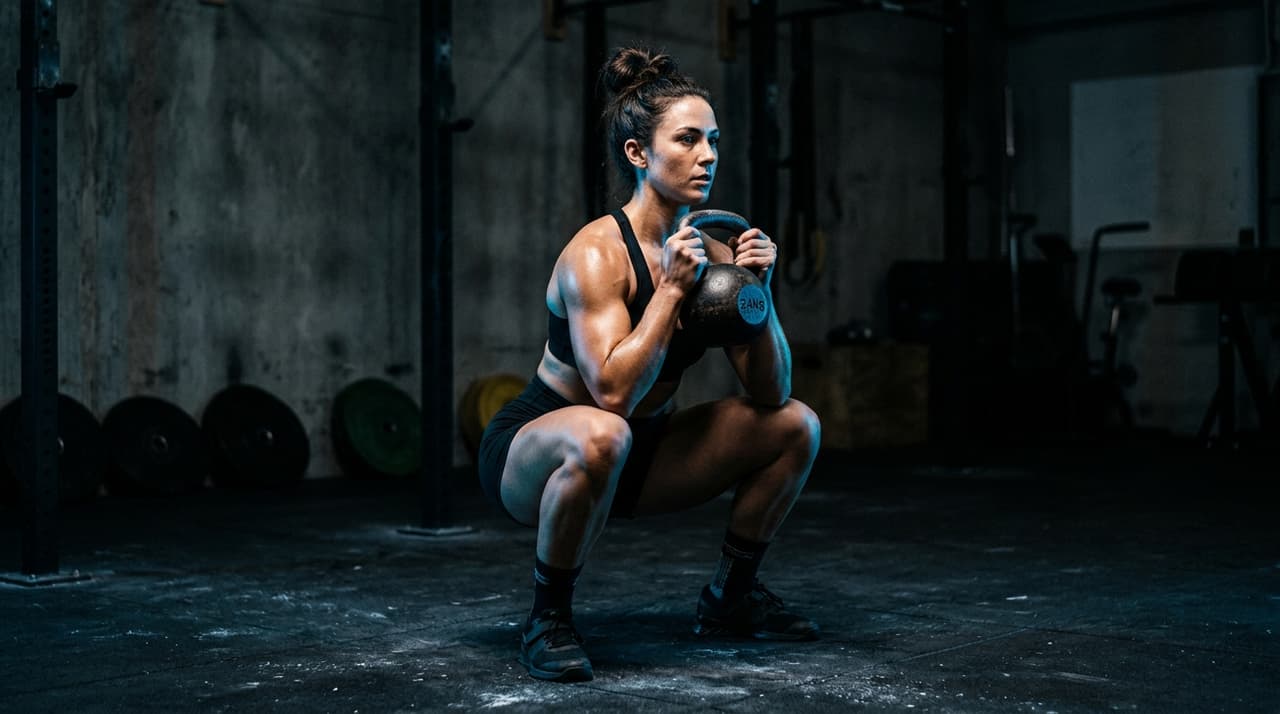
Hold the bell by the horns, not the handle. Sounds obvious. Half the people I watch grip the handle like they're about to swing it. Cup the bell where the horns meet the body, thumbs against your sternum, elbows pointed down. The bell should feel welded to your chest.
Stance is personal. Start with feet about shoulder-width, toes turned out somewhere between 15 and 30 degrees. Don't overthink it. Squat down and see what happens. If your knees cave, widen the stance slightly and turn the toes out a bit more. If your heels lift, you either need to sit back more or work on your ankle mobility.
The descent is where the exercise earns its reputation. Pull yourself down. Don't just drop. Think about pulling your hips toward the floor while keeping your chest tall and the bell tight to your body. At the bottom, your elbows should track between your knees, gently prying them open.
Stand up by driving your feet through the floor. Not by leading with your chest, not by shooting your hips up first. Whole foot, whole body. The cue that works for most people: push the earth away from you.
Loading it properly (this is where people get it wrong)
Here's the argument I keep having: people think the goblet squat has a low ceiling because you can only hold so much weight at your chest.
That's true if you only care about maximal load. But for a kettlebell athlete, that's the wrong metric.
The goblet squat scales through volume, tempo, density, and complexes. Sets of 15 to 30 with a moderate bell. Three-second descents with a two-second pause at the bottom. Goblet squats every minute on the minute for 10 to 20 minutes. Complexes like goblet squat to press, goblet squat to curl, or full thrusters.
A 24kg bell for a set of 20 controlled reps with a full pause at the bottom is genuinely hard training. If you think it's easy, you're moving too fast or not going deep enough.
For programming, I like pairing goblet squats with a pressing or pulling pattern in a superset, or using them as the primary squat in a minimalist three-exercise program. Two to four sets of 8 to 15 reps, two or three times a week, will build legs that show up for everything else.
Where FlowTimer fits
The goblet squat responds beautifully to tempo work, and tempo is impossible to hold consistently without an external cue. Try this: set a 4-count descent, 1-count pause, 1-count ascent, using audio ticks. Suddenly a set of 8 feels like a set of 20, and your positions get cleaner because you can't rush through the sticky parts.
Set up a tempo timer in FlowTimer and use it for a month of goblet squat work. You'll feel muscles you forgot about.
The mobility argument
One more thing that gets underrated: the goblet squat is a mobility drill disguised as a strength exercise.
Hold the bottom position. Just sit there. Elbows pressing gently into the inside of your knees, spine tall, breathing into your belly. Thirty seconds feels like forever the first time. This is called a goblet squat prying stretch, and it's one of the highest-ROI things you can do for hip and ankle mobility because you're loading the tissue in the exact position you want it to work in.
Combine that with some upstream work on thoracic spine mobility and your squat pattern will improve faster than any amount of foam rolling.
When to graduate (and why you shouldn't)
At some point people ask when they should move to front squats or double kettlebell front squats. Fair question.
My honest answer: you don't need to. Unless you're competing in something that requires a specific squat variation, the goblet squat with progressively heavier bells, longer tempos, and more volume will build the legs you need for the rest of your kettlebell work.
A 32kg goblet squat for a strict set of 10 is a real accomplishment. A 40kg for 5 is a serious feat of strength. Very few trainees ever get there. And when they do, their squat pattern is bulletproof.
Stop treating this like a warm-up. Your legs will thank you.
Ready to put this into practice? FlowTimer lets you build custom interval workouts, set precise work-to-rest ratios, and train with audio cues so you can focus on your form.
Try FlowTimer Free