The minimalist kettlebell program: three exercises, full body, real results
A three-exercise kettlebell program that covers your whole body. Here's how to structure it, why it works, and how to progress without adding lifts.
I used to think more exercises meant better results. Then I spent a summer traveling with a single 24kg kettlebell and did three movements for twelve weeks. I came home stronger than I'd been in years. Leaner too.
That experience changed how I think about program design. Most of us aren't undertrained, we're overcomplicated. We add lifts because we're bored, not because we need them. And boredom is a terrible reason to program anything.
So let's talk about what a real minimalist kettlebell program looks like, why three exercises is often the sweet spot, and how to make it work for months without stalling.
Why three exercises is enough
The body doesn't care how many exercises are in your program. It cares about mechanical tension, metabolic stress, and how often you show up. A 2017 meta-analysis in the Journal of Sports Sciences found that training frequency and total volume drive most adaptations, with exercise variety playing a much smaller role than lifters assume.
Here's the thing about kettlebells specifically: the tool is already compound by design. A swing hits your posterior chain, grip, core, and cardiovascular system in one movement. A press trains overhead strength, shoulder stability, and standing bracing. A goblet squat covers quads, upper back, and hip mobility. Three well-chosen kettlebell exercises can hit every major movement pattern.
Compare that to a bodybuilding split where you need six exercises just to cover the shoulders.
The three movements
Pick one from each category:
Hinge: Two-hand swing, one-hand swing, or snatch
Push: Strict press, push press, or double press
Squat/carry: Goblet squat, front squat, or double front rack carry
That's it. You have a hinge that trains your posterior chain and conditions your heart. You have a press that builds shoulders and teaches you to brace under load. You have a squat or loaded carry that keeps your legs and trunk honest.
My default recommendation for most people: two-hand swing, strict press, goblet squat. Simple, scalable, and they'll teach you more than a dozen fancy variations.
How to structure the week
Here's a four-day layout that's worked well for me and everyone I've handed it to:
| Day | Focus | Structure |
|---|---|---|
| Monday | Strength | Press 5x5, Squat 5x5, Swings 5x10 |
| Tuesday | Conditioning | Swing EMOM 20 min, 15 reps/min |
| Thursday | Strength | Press ladders (1,2,3 x 5 rounds), Squat 4x8, Swings 4x15 |
| Saturday | Density | 20 min AMRAP: 5 press/side, 10 squat, 15 swing |
Four sessions. Same three movements. Different stimulus each day. It looks boring on paper, but you'll feel the difference immediately.
The magic isn't in the exercise selection, it's in how you vary intensity, volume, and rest across the week. Monday is heavy and slow. Tuesday is a metabolic grind. Thursday plays with rep schemes. Saturday tests work capacity. Same tools, four different adaptations.
If you want to run this without doing math in your head every session, a timer helps a lot. Set up your EMOMs and AMRAPs in FlowTimer so you can focus on the work instead of watching a clock.
The progression problem (and how to solve it)
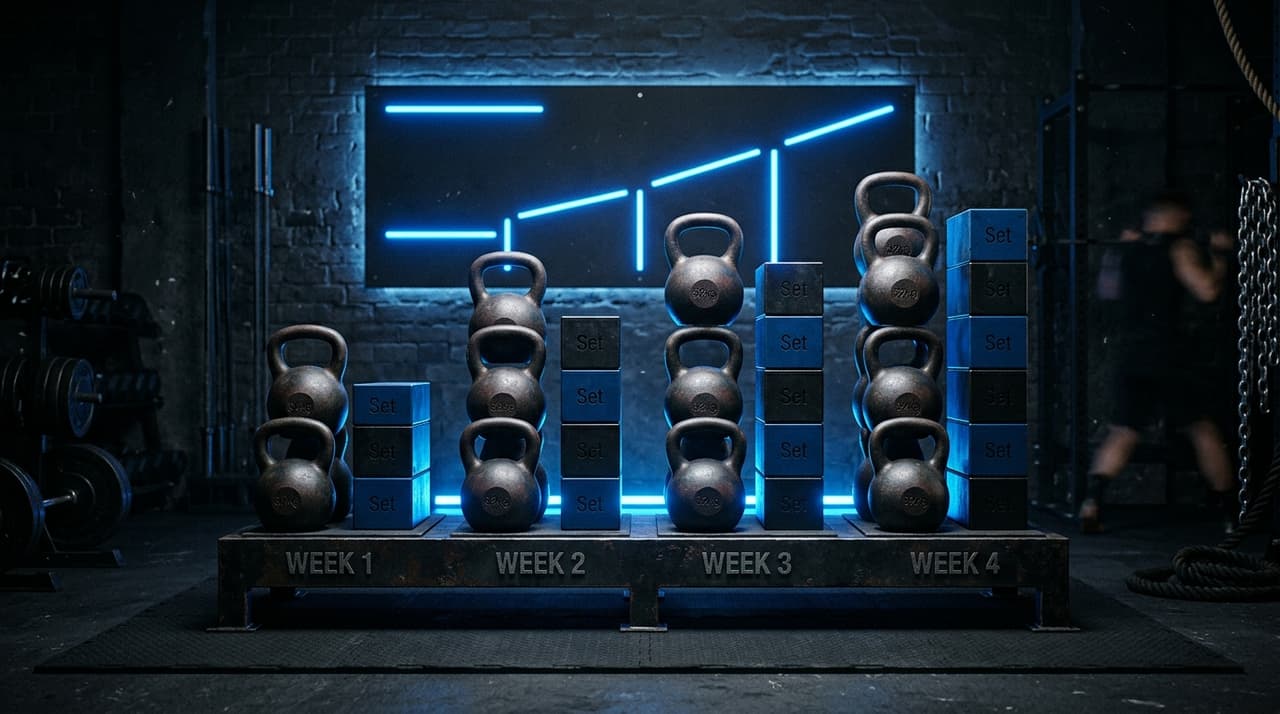
Here's where most minimalist programs die: people think progression means adding a fourth exercise. Don't. Progression in a minimalist program comes from manipulating the variables you already have.
I wrote a whole piece on this called progressive overload beyond adding weight, but the short version for a three-exercise program:
Week 1-3: Build volume. Add a rep or two per set each week.
Week 4-6: Compress rest. You're doing the same volume, just in less time. This hurts.
Week 7-9: Add load. New bell, or switch to double kettlebells for the press and squat.
Week 10-12: Test. Max reps, max load, or a benchmark workout like 100 snatches for time.
Then deload a week and start over with the new baseline. You can run this loop for a year on three exercises and never plateau. I've seen it.

What you give up
Let's be honest about the tradeoffs. A three-exercise program isn't optimal for everything. You won't build maximal biceps this way. You're not going to develop specialized skills like the bent press or the Turkish get-up unless you sub them in. If your goal is powerlifting totals or bodybuilding aesthetics, this isn't your program.
What you get instead: strength that carries over to real tasks, conditioning that most gym rats can't match, and a training practice that fits into a lunch break. You also get very good at three movements, which matters more than being mediocre at fifteen.
Who this works for
Busy adults with 30-45 minutes to train. People who travel and can't rely on a full gym. Beginners who need to build a foundation before adding complexity. Advanced lifters who want to strip things back and rediscover why they started.
Who it doesn't work for: sport-specific athletes with technical demands, people who genuinely love exercise variety and will quit if bored, or anyone chasing a specific aesthetic outcome that requires isolation work.
A note on kettlebell selection
One bell is enough to start. Men usually do well with a 20 or 24kg. Women often start with 12 or 16kg. If you're going to invest, get two bells about 8kg apart so you can go heavier on squats and presses while keeping a manageable weight for high-rep swings.
But don't let equipment stop you. I've written entire programs for people with a single bell that got them stronger than they'd ever been. The bell isn't the limit. Your consistency is.
Three exercises. Four days a week. Twelve weeks. Then reassess. That's the whole thing. The people who succeed with minimalist training aren't the ones with the fanciest programs, they're the ones who show up and do the boring work long enough to see it pay off.
Ready to put this into practice? FlowTimer lets you build custom interval workouts, set precise work-to-rest ratios, and train with audio cues so you can focus on your form.
Try FlowTimer Free