Grip strength recovery between heavy sets: how long you actually need
Your grip fails before your legs do. Here's what research says about how long forearm muscles need between heavy kettlebell sets.
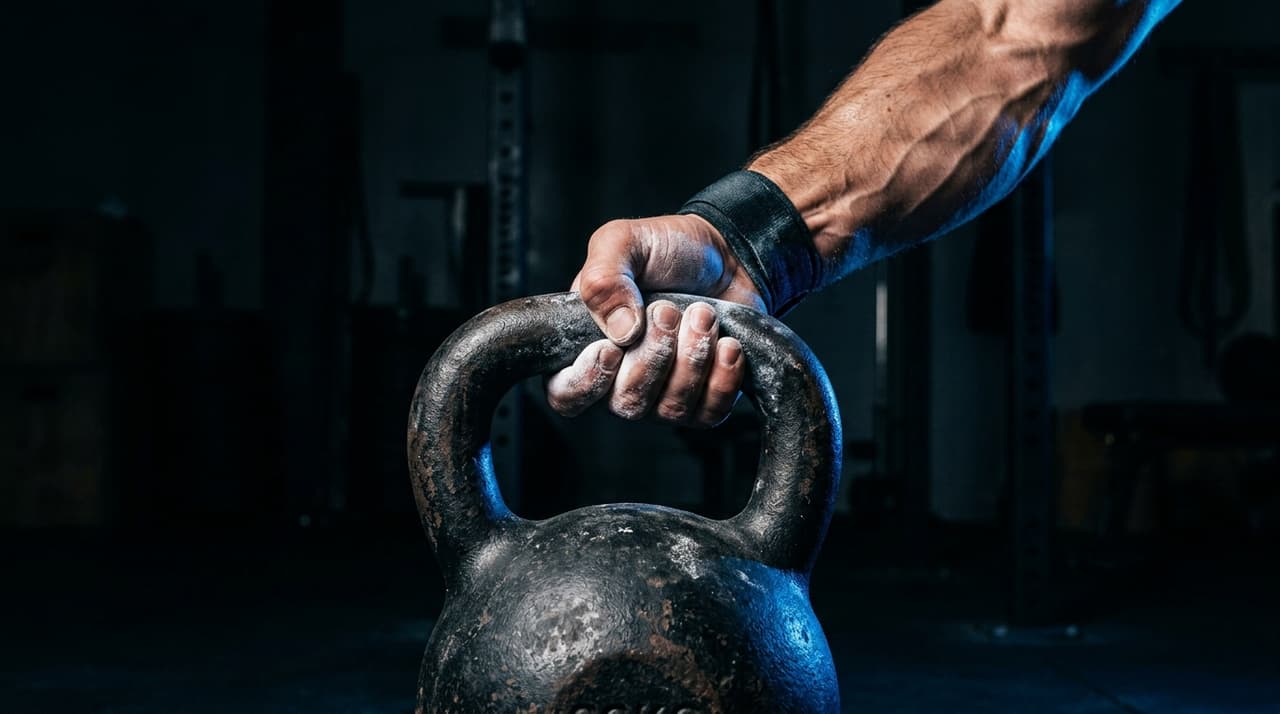
You know the feeling. Third set of heavy one-arm swings, and it's not your hips or your lungs that quit. It's your hands. Your fingers start unpeeling from the handle like they've made a unilateral decision to clock out.
Grip failure is the most common performance bottleneck in kettlebell training, and it's one of the least discussed. We obsess over hip hinge mechanics and breathing strategies, but the kinetic chain literally passes through your hands. When grip goes, everything goes.
So here's the question that actually matters: how long do your forearm muscles need between heavy sets to perform again?
What's happening in your forearms
The muscles responsible for grip—the flexor digitorum superficialis and profundus, plus the flexor pollicis longus—are small muscles doing enormous work during kettlebell training. A heavy swing or clean demands both crushing grip (squeezing the handle) and support grip (preventing the bell from flying away). That dual demand costs a lot metabolically for muscles with limited blood flow capacity.
Here's what makes forearm fatigue different from, say, quad fatigue. The forearm flexors have a high proportion of slow-twitch fibers (studies vary, but estimates run 55-65% Type I in the forearm flexors). That's good news for endurance. But during heavy kettlebell work, you're also recruiting the fast-twitch fibers hard, especially at the top of a swing when centrifugal force peaks. Those fibers fatigue faster and take longer to clear metabolic byproducts.
A 2012 study in the Journal of Electromyography and Kinesiology found that maximal grip force declined by about 55% after sustained gripping at 50% of maximum voluntary contraction for just 60 seconds. Recovery to 90% of baseline took roughly 3-5 minutes. That's for a static hold. Ballistic kettlebell work involves repeated high-force contractions with brief relaxation periods between reps, which changes the recovery picture somewhat.
The research on inter-set grip recovery
A 2015 study published in the Journal of Strength and Conditioning Research measured handgrip force recovery across different rest intervals. Subjects performed maximal grip efforts, then rested for 1, 2, 3, or 5 minutes before retesting. The findings were clear but a little uncomfortable for anyone who likes short rest periods:
| Rest interval | Grip force recovery (% of baseline) |
|---|---|
| 1 minute | 72-78% |
| 2 minutes | 82-88% |
| 3 minutes | 90-94% |
| 5 minutes | 96-99% |
I keep coming back to that 1-minute row. If you're resting 60 seconds between heavy sets (which is common in conditioning-focused programs), you're starting your next set with roughly three-quarters of your grip capacity. That compounds. By set four or five, you're running on fumes.
Now, kettlebell work isn't identical to a maximal isometric grip test. During a swing, you get micro-moments of relative relaxation at the bottom of the arc. But you're also dealing with dynamic forces that exceed the static weight of the bell, sometimes by 2-3x at the top of a hard swing. Research from a 2013 biomechanical analysis showed that peak grip demand during a kettlebell swing can reach 1.5-2.5 times the bell's weight, depending on swing style and effort.
Your forearms are working harder than you think. And recovering slower than you'd like.
Practical recovery strategies that actually work
Knowing the physiology is only useful if it changes what you do in the gym. Here's what I've found works, both from the literature and from years of training with heavy bells.
Open your hands between sets. This sounds stupidly simple, but actively extending your fingers during rest periods increases blood flow to the forearm flexors. A 2018 study in the European Journal of Applied Physiology showed that active recovery (low-intensity contractions of antagonist muscles) improved grip recovery by 12-15% compared to passive rest. Spread your fingers wide, make a fist, repeat. Do this for the first 30 seconds of your rest period.
Rest 2-3 minutes for heavy work, minimum. If you're training with a bell that challenges your grip (and you should be sometimes), 90-second rest periods are a compromise that leaves performance on the table. Three minutes gets you to that 90%+ recovery zone. For your heaviest sets, don't be embarrassed about taking five.
This pairs well with what we know about rest intervals for strength versus hypertrophy. If your primary goal is strength or power output, longer rest isn't laziness. It's programming.
Alternate hands strategically. If you're doing one-arm work, switching sides doubles your grip rest for each hand. A set of 10 left-hand swings followed immediately by 10 right-hand swings, then rest, gives each hand roughly 20-30 seconds of passive recovery during the opposite set. Not a full rest interval, but the cumulative effect is real.

Consider your programming structure. If you're doing a session with multiple grip-intensive movements (swings, cleans, snatches, Turkish get-ups), sequence matters. Front-loading your heaviest grip work when your forearms are fresh seems obvious, but I see people do heavy snatches after 15 minutes of swings and then wonder why they can't hold on.
This is one of the overlooked dimensions of progressive overload: managing fatigue accumulation across a session, not just across a training block.
The timer problem (and a fix)
Here's what bugs me about most interval timer setups for heavy kettlebell work. They enforce uniform rest periods. Same 60 or 90 seconds between every set, regardless of what your grip is telling you. That works fine for conditioning circuits with lighter bells. It's terrible for heavy work where grip is the limiting factor.
What you actually want is variable rest. Maybe 90 seconds after a moderate set, but 3 minutes after a maximal effort. FlowTimer lets you build custom intervals that match the real demands of your training instead of forcing you into a one-size-fits-all structure. Set up different rest durations for different blocks in the same workout. Your forearms will thank you.
Building grip that lasts
Long-term, the goal isn't just managing grip fatigue. It's pushing the ceiling higher so fatigue matters less.
A few approaches with actual evidence behind them:
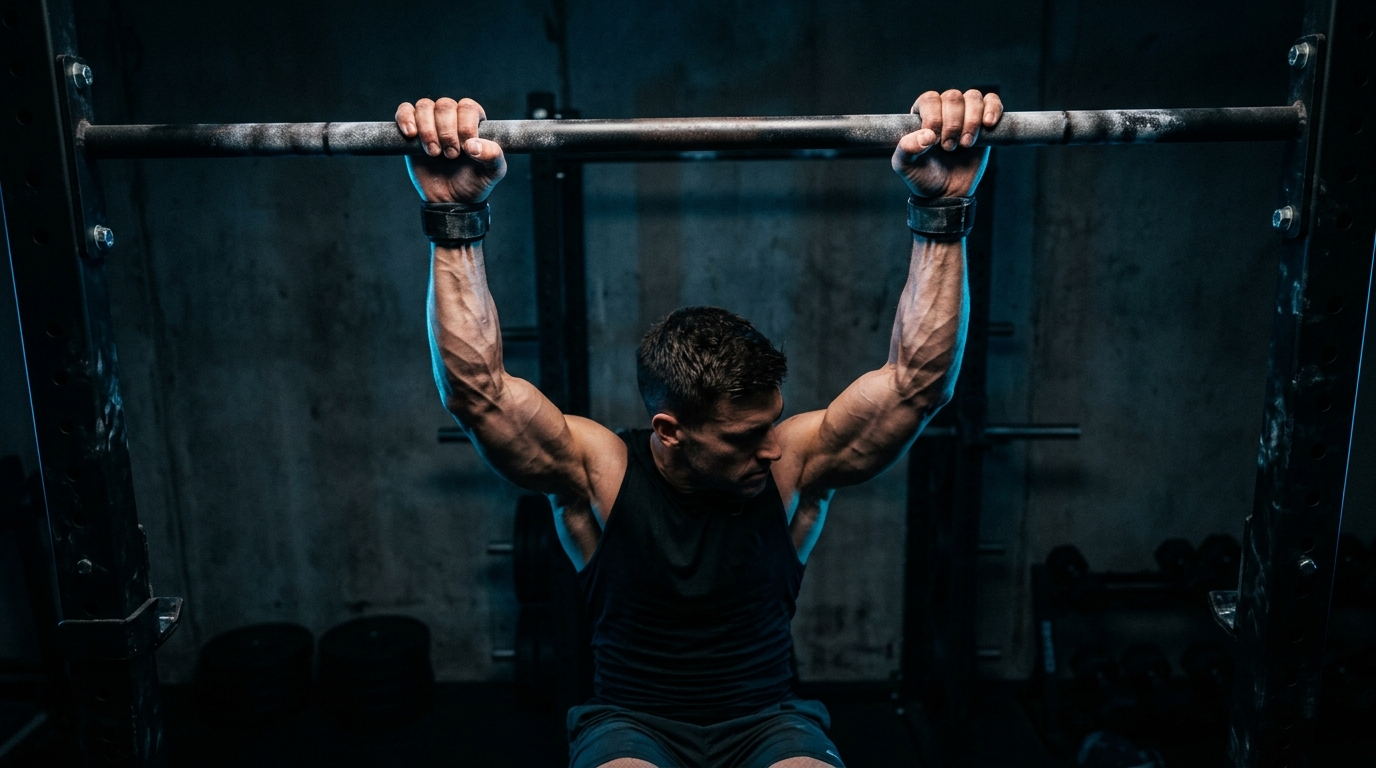
Dead hangs are boring and they work. A 2019 study in the Journal of Hand Therapy found that 4 weeks of daily dead hang practice (accumulating 2-3 minutes total hang time per session) improved grip endurance by about 20%. The key is total time under tension, not single-set duration. Five sets of 30 seconds beats one set of 2.5 minutes for most people.
Fat grip training, using a thicker handle or wrap, forces greater muscle activation in the forearm flexors. A study in the Journal of Strength and Conditioning Research (2020) showed that training with a 2-inch diameter handle produced significantly greater forearm EMG activity than a standard 1.25-inch handle. You don't need to do this every session. Once or twice a week with moderate loads is enough stimulus.
And something people overlook: train your extensors too. The muscles on the back of your forearm that open your hand are typically underdeveloped relative to the flexors. Rubber band extensions (wrapping a thick rubber band around your fingers and opening against resistance) take about two minutes and help balance the joint, which may reduce injury risk at the wrist and elbow.
The bottom line
Your grip recovers on its own timeline. That timeline is slower than most people program for. The data points to 3 minutes as the sweet spot for near-full recovery between heavy sets, with diminishing returns beyond 5 minutes. One minute is fine for lighter conditioning work but leaves you weaker for heavy efforts.
Pay attention to your hands the way you pay attention to your hips. They're doing more work than you realize, and they're the weakest link in the chain for most kettlebell athletes. Program your rest accordingly. Build grip capacity over time. And stop pretending that dropping a bell on set five is a character flaw—it's a physiology problem with a simple fix: rest longer, and your grip gets stronger.
Ready to put this into practice? FlowTimer lets you build custom interval workouts, set precise work-to-rest ratios, and train with audio cues so you can focus on your form.
Try FlowTimer Free