Sleep and training performance: the variable you're probably ignoring
How sleep quality affects strength, power, and recovery for kettlebell and steel mace athletes, plus practical fixes that actually move the needle.
You can dial in your programming, fix your swing mechanics, eat clean, and still feel like garbage in the gym if you're sleeping six hours a night. I keep coming back to this because it's the most under-discussed variable in strength sport. People will argue for an hour about rep schemes and then go home and watch YouTube until 1am.
Let's talk about what sleep actually does to your training, what the research says, and what to do about it without turning into one of those biohacker types who needs four supplements and a $2000 mattress cover to feel okay.
What happens to a sleep-deprived lifter
A 2018 systematic review in Sports Medicine by Knufinke and colleagues pulled together the evidence on sleep and athletic performance. The findings are pretty consistent. After partial sleep deprivation (think 4-5 hours for one to two nights), maximal strength output on compound lifts drops somewhere between 4 and 11 percent. Power output, the thing that matters most for swings, snatches, and any kind of ballistic mace work, takes an even bigger hit.
A 2019 study in the Journal of Strength and Conditioning Research had subjects perform bench press, deadlift, and leg press after either a normal night or a restricted night of sleep (around three hours). Total volume on the restricted night dropped significantly across all three lifts. Subjects also rated the same loads as harder, meaning RPE creeps up even when the bar weight hasn't changed.
What bugs me about how this gets talked about is the assumption that you'll feel tired. You often won't. Subjective sleepiness adapts to chronic restriction. You think you're fine. Your nervous system disagrees.
Why power output suffers more than strength
Grinding out a heavy double-arm swing requires recruiting high-threshold motor units fast. That recruitment depends on central nervous system drive, which is one of the first things to degrade under sleep loss. A 2017 paper in the European Journal of Applied Physiology measured countermovement jump height after sleep restriction and found a clear drop in peak power within 24 hours, even when subjects reported feeling "okay."
For kettlebell and mace athletes, this matters more than it does for a powerlifter. Our sport is built on repeated power expression. A snatch test, a 10-minute clean and jerk set, mace 360s for time. These all live in a zone where small drops in rate of force development add up across hundreds of reps. Miss a few percent on rep one and you're cooked by rep fifty.
Recovery, hormones, and the boring stuff that actually matters
Growth hormone secretion peaks during slow-wave sleep, which mostly happens in the first half of the night. Testosterone production follows a similar pattern, with morning levels closely tied to total sleep duration.
A well-known 2011 study in JAMA showed that one week of restricted sleep (5 hours per night) reduced testosterone in young healthy men by 10-15 percent. That's the kind of drop you'd panic about if it showed up on a blood panel.
Sleep also drives the inflammatory cleanup work your body does between sessions. Skimp on it consistently and DOMS lingers, joints feel cranky, and you end up auto-regulating yourself into easier sessions because you can't recover from the hard ones. If you want to understand why fixed programs stop working when life gets in the way, autoregulation is part of the answer, but sleep is upstream of all of it.
What to actually do
Here's where most sleep articles fall apart. They tell you to meditate and avoid blue light and somehow get nine hours. That's not useful. Let me give you a hierarchy.
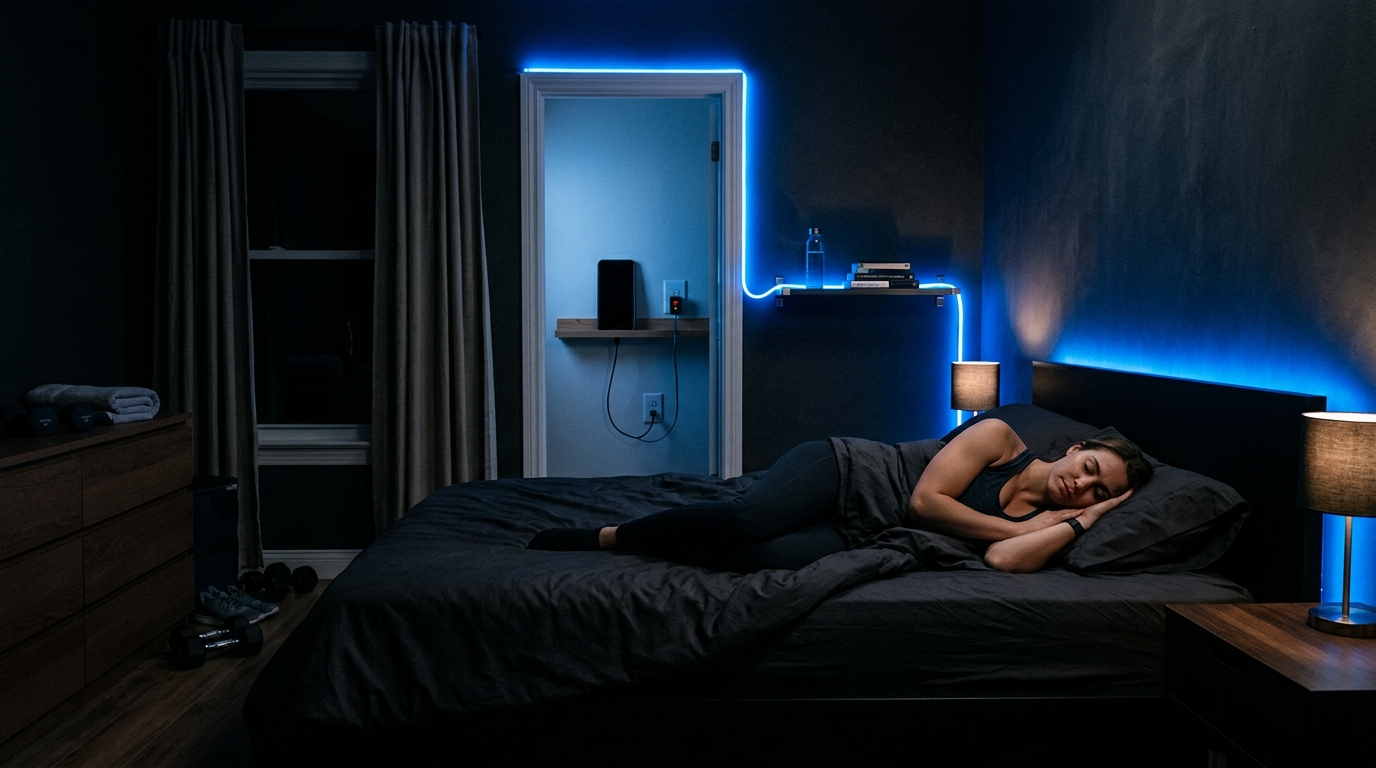
Total duration is the big lever. If you're sleeping under seven hours regularly, nothing else matters as much as adding more time in bed. Not in front of the TV. In bed, lights off. Aim for seven and a half to eight hours of opportunity, which usually nets around seven hours of actual sleep.
Consistency beats perfection. Going to bed and waking up at roughly the same time (within a 30-minute window) does more for sleep quality than any supplement on the market. Your circadian system loves predictability. I've watched people add an hour of sleep by just setting a bedtime alarm. Sounds stupid. Works.
Train earlier when possible. Late-evening hard sessions raise core temperature and sympathetic drive at exactly the wrong time. If you have to train late, give yourself 90 minutes of wind-down before bed. A 2020 review in Nature and Science of Sleep found that high-intensity exercise within an hour of bedtime measurably reduced sleep efficiency, while sessions completed two or more hours before bed had no negative effect.
Caffeine has a longer tail than you think. The half-life of caffeine is 5-6 hours, but in some people it's closer to 9. A 2 pm coffee is still working at 8 pm. If you're using caffeine to push through afternoon workouts, you might be quietly torching your sleep quality.
How to know if it's working
Track two things for two weeks. Morning resting heart rate (taken before you sit up) and a simple readiness rating from 1-10. If you add an hour of sleep per night and your resting HR drops 3-5 beats and your readiness ratings climb, you have your answer.
This ties directly into how you should be structuring rest within sessions too. When recovery is poor, grip and CNS recovery between sets takes longer, and pushing the same work-to-rest ratios you used when you were fresh just buries you deeper.
If you want to actually measure how this plays out session to session, you need consistent timing on your sets and rest. Set up your work and rest intervals in FlowTimer and stop estimating recovery on a sleep-deprived nervous system.
The honest summary
Sleep isn't sexy. Nobody wants to hear that the answer to their plateau might be going to bed an hour earlier instead of switching to a new program.
But the evidence is clear: chronic sleep restriction lowers strength, lowers power, raises perceived effort, blunts recovery, and quietly drags down your hormones. If you're sleeping less than seven hours regularly, start there before you change your program, your diet, or your accessory work.
Your programming will work better. Your sessions will feel sharper. And you'll stop wondering why the same swing weight feels different on different days. Most of the time, it's the sleep.
Ready to put this into practice? FlowTimer lets you build custom interval workouts, set precise work-to-rest ratios, and train with audio cues so you can focus on your form.
Try FlowTimer Free