What to track in your training journal (and what to ignore)
A practical guide to training journals for kettlebell and steel mace athletes. What actually moves the needle, what's just noise.
I resisted keeping a training journal for years. It felt like the kind of thing serious athletes did, and I wasn't sure I qualified. Then I went through a six-month stretch where my swings felt heavier every week despite no real change in programming, and I had no way to figure out why. No data. Just vibes and a vague sense that something was off.
That's when I started writing things down. Badly at first. Too much detail, then not enough, then the wrong details entirely. It took me probably a year to figure out what was actually worth tracking and what was just noise dressed up as discipline.
Here's what I've landed on.
The point of a journal isn't to record everything
This is where most people go wrong. They open a notebook (or some color-coded spreadsheet) and try to capture every variable: sets, reps, weight, rest, RPE, sleep, mood, what they ate, the weather. Two weeks later they stop because logging takes longer than the warm-up.
A training journal answers one question: what's changing, and is it the thing I want to change?
That's it. Everything you track should serve that question. If a data point isn't going to influence a future decision, don't bother writing it down.
What actually belongs in there
For kettlebell and mace work, I track four things consistently. Sometimes a fifth.
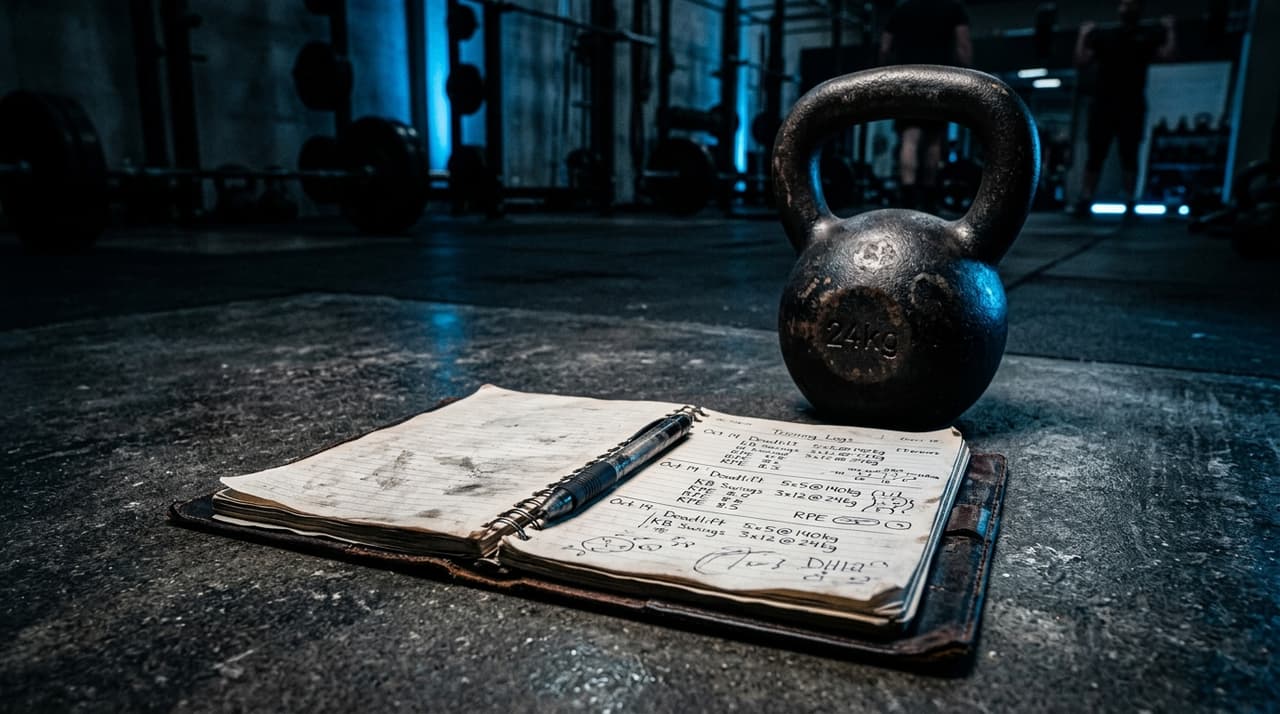
The session itself. Movements, load, sets, reps or time. Not in narrative form. Just enough to reconstruct what I did if I had to repeat it. "5x10 swings @ 32kg, 60s rest" is plenty. I don't need adjectives.
A subjective effort score. This is just RPE, the rate of perceived exertion on a 1-10 scale. I write it next to the work. If 5x10 swings at 32kg felt like a 6 in March and a 9 in July with no change in load or volume, something's going on. Either I'm cooked from poor recovery, or my conditioning's regressed, or I'm under-eating. The number itself doesn't diagnose anything. It just flags that a conversation needs to happen.
One sentence on how it felt. Not a paragraph. One sentence. "Left shoulder cranky on the overhead presses." "Hinge felt sharp today." "Grip gave out before lungs." These breadcrumbs become incredibly useful when you flip back through three months later trying to figure out when a nagging issue started.
Sleep, roughly. I don't need a Whoop score. I write down hours slept and whether it felt restful. That's it. The correlation between sleep and how my sessions go is, embarrassingly, the strongest signal in my whole journal. I wrote more about this in the sleep article if you want to nerd out on it.
The optional fifth thing is bodyweight, but only if you're actively trying to change it. Otherwise it's just noise that'll make you anxious on the wrong days.
What to leave out
Macros, unless you're a competitive athlete in a weight class. Mood ratings, unless you're working with a therapist on something specific. Detailed warm-up notes. Every set of every accessory exercise. Heart rate variability scores you don't know how to interpret.
I'm not saying this stuff is worthless. I'm saying that when you try to track everything, you track nothing well. The journal becomes a chore, you skip days, and then the gaps make the whole thing useless because you can't see patterns in incomplete data.
Start minimal. Add things only when you have a specific question you're trying to answer.
How to actually review it
This is the part almost nobody does, and it's where the value lives. Writing things down without ever looking back is just journaling theater.
Once a month, sit down for fifteen minutes and read the last four weeks. Look for patterns. Are your RPEs creeping up while load stays flat? You might be under-recovered. Are certain movements consistently feeling worse on certain days of the week? Could be scheduling. Did your bad sessions cluster around a stretch of poor sleep? Probably not a coincidence.
This is where the journal earns its keep. It turns scattered observations into actual decisions: drop volume, add a rest day, fix sleep, change the order of your sessions.
The link between journaling and timed training
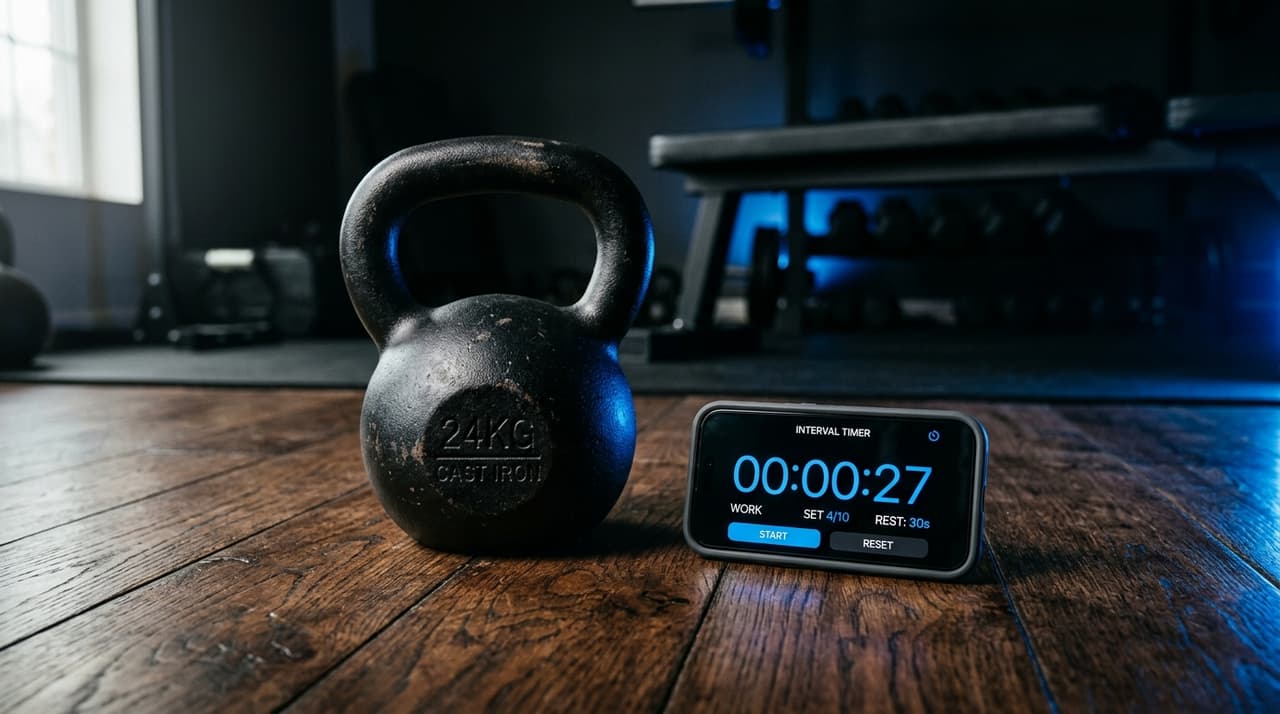
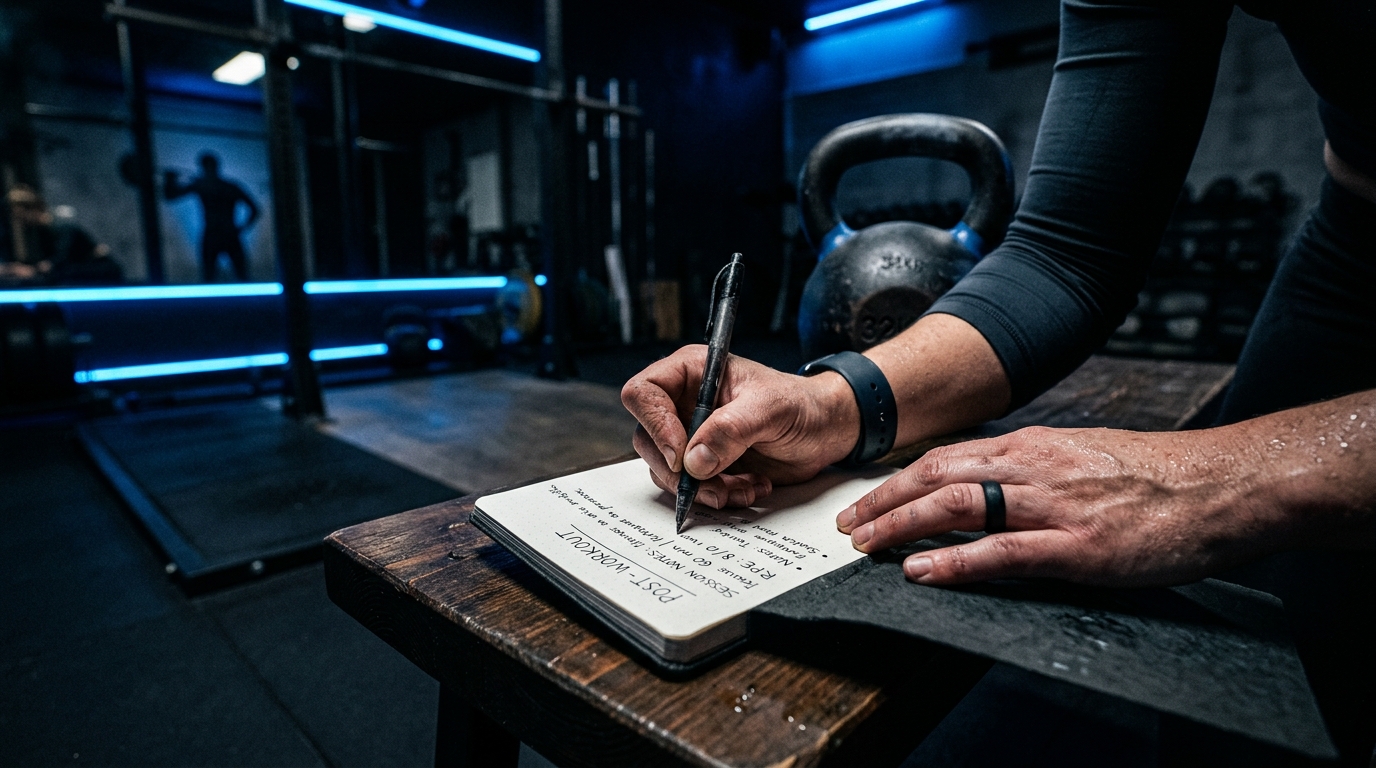
One reason I love timer-based training is that it makes the data collection nearly automatic. You're already structuring work and rest in known intervals. You're already paying attention to outputs (reps completed, rounds finished, work density). The journal entry basically writes itself.
If you're using FlowTimer to run your sessions, the session itself becomes the rough draft of your log. Round counts, work-to-rest ratios, total time under load. All of that's measured. You just add the subjective layer: how it felt, what hurt, what surprised you. That combination of hard numbers and quick gut-check notes is, in my experience, the most useful version of a training journal you can keep.
A practical starting template
Here's the format I'd suggest if you're starting from zero. Steal it, modify it, throw out what doesn't fit.
| Field | Example |
|---|---|
| Date | Tue Mar 12 |
| Session | 20-min EMOM, 10 swings @ 28kg, 5 goblet squats |
| RPE | 7 |
| Notes | Grip held up better than expected. Squats felt grindy by round 15. |
| Sleep | 7h, decent |
Five lines. Maybe two minutes to fill out. After a month you'll have enough data to start seeing what your body's actually telling you, and you'll have made the leap from training by feel to training with feel plus evidence. Those are very different things.
The journal isn't a productivity hack or a discipline test. It's just a memory aid for you as you try to make decisions about a body that changes from week to week. Treat it that way and it'll quietly become one of the more useful tools you have. And if you're someone who tends to bail on programs when they stop feeling fresh, the autoregulation piece pairs well with this. The journal gives you the inputs. Autoregulation tells you what to do with them.
Ready to put this into practice? FlowTimer lets you build custom interval workouts, set precise work-to-rest ratios, and train with audio cues so you can focus on your form.
Try FlowTimer Free