
How to Use an Interval Timer for HIIT Workouts (Step-by-Step Guide)
Learn how to set up an interval timer for HIIT workouts. Covers work-to-rest ratios, timer features, protocols for every level, and common mistakes to avoid.
High-Intensity Interval Training (HIIT) has become one of the most efficient ways to burn fat, build endurance, and get maximum results from your workouts. But here's what catches most people off guard: without proper timing, you'll either coast through work intervals or cut recovery periods short.
Precise timing separates effective HIIT from just another sweaty workout. Counting in your head or checking a wall clock kills your focus and breaks the intensity that makes HIIT work. An interval timer keeps you locked into the rhythm while you pour everything into each rep.
What Makes HIIT Different from Regular Cardio
HIIT alternates between short bursts of all-out effort and brief recovery periods. Unlike steady-state cardio where you cruise at one pace, HIIT forces your body to use different energy systems, creating an "afterburn effect" that keeps burning calories long after you're done.
The key is contrast. Work intervals should push you to 80-95% of your max heart rate. Rest intervals give you just enough recovery to attack the next round with similar intensity. This structure is what separates real HIIT from random bursts of hard exercise.
Essential Timer Features for HIIT Success
Not every timer works for interval training. Your HIIT timer needs specific features to support intense, focused sessions.
Audio Cues Are Everything
Visual timers make you look away from your movement, breaking focus and potentially messing up your form. Audio cues—beeps, voice commands, or music changes—let you stay completely dialed in while getting clear timing signals.
Customizable Intervals
Different HIIT protocols need different timing structures. Look for a timer that handles work intervals from 15 seconds to 4 minutes, rest periods from 10 seconds to 2 minutes, and 4 to 20 rounds. Plus, you need prep time—those crucial seconds to get positioned before things get intense.
Round Counting
When your lungs are burning and your legs feel like jelly, mental math becomes impossible. Audio announcements like "Round 3 of 8" keep you mentally engaged and help you distribute your energy wisely.
Step-by-Step HIIT Timer Setup
Step 1: Choose Your HIIT Protocol
Pick from these tested ratios based on where you're at:
Beginner Protocol (1:2 ratio)
- Work: 30 seconds
- Rest: 60 seconds
- Rounds: 6-8
- Total time: 9-12 minutes
Intermediate Protocol (1:1 ratio)
- Work: 45 seconds
- Rest: 45 seconds
- Rounds: 8-10
- Total time: 12-15 minutes
Advanced Protocol (2:1 ratio)
- Work: 40 seconds
- Rest: 20 seconds
- Rounds: 12-15
- Total time: 12-15 minutes
Step 2: Configure Your Timer Settings
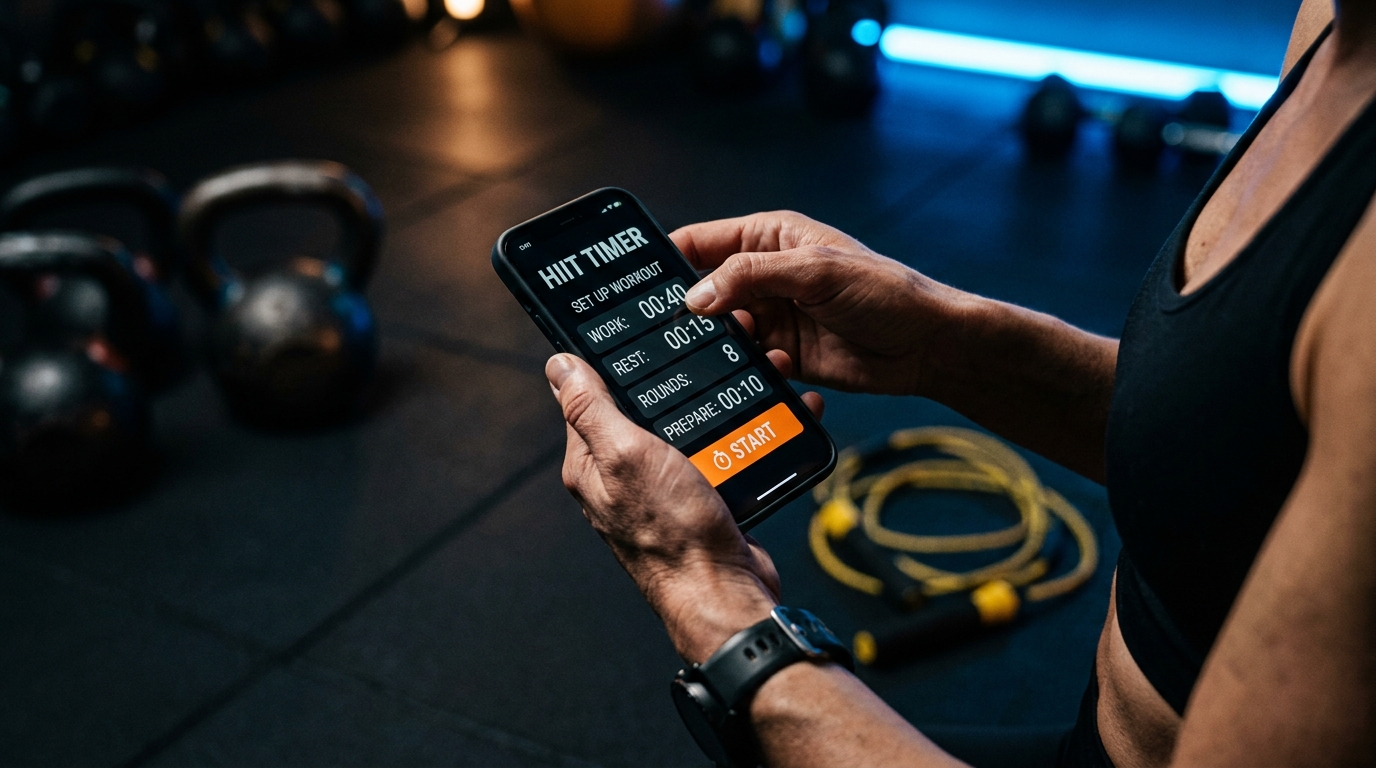
Open your interval timer and plug in these settings:
- Prep time: 10-15 seconds to get positioned
- Work interval: Your chosen duration
- Rest interval: Recovery time based on your protocol
- Rounds: Total cycles you're planning
- Audio cues: Enable voice announcements and beeps
- Warning signals: A 5-second heads-up before transitions keeps you ready
Step 3: Test Your Setup
Before jumping in, run a quick test:
- Start the timer and listen to the cues
- Practice moving between work and rest positions
- Adjust volume so you can hear over heavy breathing
- Make sure the timing feels right for your exercises
Optimal Work-to-Rest Ratios for Different Goals
Match your work-to-rest ratio to what you're trying to achieve.
Fat Loss Focus (1:1 to 1:2 ratios)
For fat loss, you need enough recovery to hit each round hard without completely burning out. This approach keeps your calorie burn high during the workout and triggers the metabolic afterburn that continues working long after you're done.
Example Setup:
- Work: 30-45 seconds at 85-90% effort
- Rest: 30-60 seconds
- Focus: Compound moves like burpees, mountain climbers, squat jumps
Cardiovascular Endurance (2:1 to 3:1 ratios)
Building cardiovascular fitness means challenging your heart's recovery ability with shorter rest periods.
Example Setup:
- Work: 60 seconds at 80-85% effort
- Rest: 20-30 seconds
- Focus: Continuous patterns like cycling, rowing, or running
Power Development (1:3 to 1:5 ratios)
Power training demands longer recovery. Your muscles need time to replenish energy stores between explosive efforts. Rushing this process reduces your power output.
Example Setup:
- Work: 15-30 seconds at 95%+ effort
- Rest: 60-150 seconds
- Focus: Explosive moves like sprints, plyometric jumps, heavy bag work
Common HIIT Timer Mistakes to Avoid
Starting Too Aggressively
Many people set overly ambitious intervals on day one. If you're dying by the final rounds, your intervals are too long or rest too short. Start conservative and build up.
Skipping the Warm-Up Timer
Jumping straight into max intensity is asking for injury. Use your prep phase for dynamic warm-up movements, not just getting into position.
Half-Hearted Effort
The timer only works if you respect the intensity demands. Work intervals should feel genuinely tough. If you can chat easily, crank up the intensity or extend the work period.
Forgetting Cool-Down Structure
Set a separate 5-10 minute timer for cool-down after HIIT. Your heart rate needs to come down gradually, not slam on the brakes.
Advanced Timer Techniques
Pyramid Intervals
Build intensity up then back down with ascending and descending work periods:
- Round 1: 20 seconds work, 40 seconds rest
- Round 2: 30 seconds work, 30 seconds rest
- Round 3: 40 seconds work, 20 seconds rest
- Round 4: 30 seconds work, 30 seconds rest
- Round 5: 20 seconds work, 40 seconds rest
Tabata Protocol
This 4-minute protocol is all about precision:
- Work: 20 seconds maximum effort
- Rest: 10 seconds complete rest
- Rounds: 8 total
- Total time: 4 minutes
Don't mess with these intervals. Tabata's effectiveness comes from sticking to the exact timing.
Circuit Integration
For multi-exercise HIIT circuits, program different audio cues for exercise transitions versus rest periods. This keeps you moving quickly between stations while maintaining proper timing.

Choosing the Right Exercises for Timed Intervals
Your exercise selection should match interval duration and flow smoothly with audio cues.
15-30 Second Intervals Perfect for explosive, high-power movements. Examples: Sprint intervals, jump squats, battle rope slams, boxing combinations
30-60 Second Intervals Great for compound movements that you can sustain with intensity. Examples: Burpees, mountain climbers, kettlebell swings, rowing intervals
60+ Second Intervals Best suited for endurance-focused movements. Examples: Cycling, running, swimming, sustained bodyweight circuits
Tracking Progress with Timed Workouts
Consistent timing lets you measure real improvement. Track these metrics:
- How many rounds you complete at target intensity
- Heart rate recovery between intervals
- Perceived exertion (1-10 scale) for each round
- Total session duration including warm-up and cool-down
Technology Solutions for HIIT Timing
Simple interval timer apps handle basic protocols fine, but specialized fitness apps offer features that can seriously upgrade your training. Look for complex interval programming, exercise guidance during timed rounds, and adaptive timing that responds to your performance.
Some athletes prefer apps that merge interval timing with complete workout programming, eliminating the need to plan exercises and timing separately.
Making HIIT Timer Training Sustainable
The best HIIT timer setup is one you'll actually stick with. Start simple with basic protocols and features, then add complexity as the timing becomes second nature.
Your training environment matters when choosing timer features. Home workouts might benefit from music integration, while gym sessions require audio that punches through ambient noise.
Conclusion
Without proper timing, HIIT turns into just another brutal workout that lacks the structure needed for real results. An interval timer transforms chaotic high-intensity sessions into focused, progressive training that actually delivers.
Your success comes down to matching timer setup with your goals, fitness level, and exercise choices. Stick with proven protocols, maintain intensity throughout every round, and let the timer handle the timing while you focus on crushing each interval.
Ready to experience what proper interval timing can do for your HIIT workouts? Try FlowTimer and discover how advanced timing features can take your training to the next level.
Ready to put this into practice? FlowTimer lets you build custom interval workouts, set precise work-to-rest ratios, and train with audio cues so you can focus on your form.
Try FlowTimer Free